The Role of Emotions in Negotiation

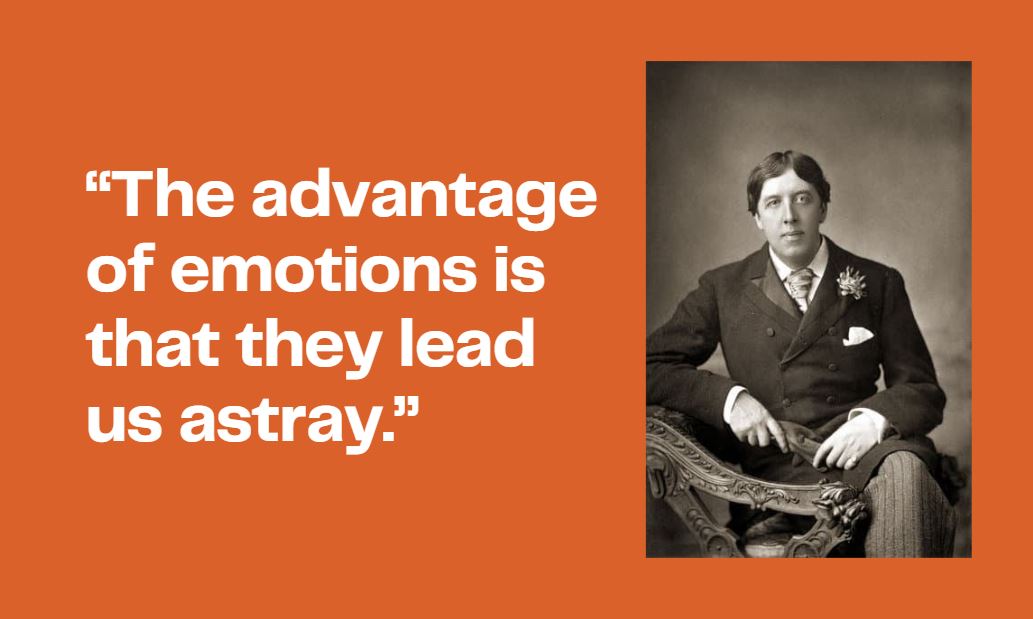
While intended to be funny, this Oscar Wilde quote can hold true in a negotiation.

Negotiations can be a tense and emotional experience. Many people believe that emotions should be left out of negotiations but, surprisingly, they play a significant role in the process.

Emotions can motivate people to reach a compromise, help build trust, and create a positive outcome for both parties.

When emotions run high, it’s important to acknowledge and manage them effectively. Emotions such as anger, fear, and frustration can quickly escalate and cause a negotiation to fail. On the other hand, emotions like empathy, gratitude, and happiness can lead to a successful outcome.

One way to use emotions to your advantage in a negotiation is by building rapport with the other party. If you can establish a connection based on trust and mutual respect, it can lead to a more positive and productive negotiation. Show empathy and understanding towards the other party, and try to find common ground that you can both agree on.

 

Negotiation has an image problem

People don’t know that they should learn to negotiate.

They think negotiation is something that only people in business suits do, or something that involves large sums of money. Or even an activity involving hostages and camouflage!

But, at the heart of negotiation is, simply, the desire to get something from someone else.

Negotiation means working out what you want; asking the other party for it; understanding their needs; anticipating and responding to any setbacks; and confirming what you’ve agreed.

We do this in our homes every week when we have the discussion about which takeaway food to order. This is no less a negotiation than what goes on at the UN. Maybe the stakes are higher at the UN and the issues are more complex … but the discussion about whether tonight should involve sushi or pizza is still a negotiation.

Regardless of negotiation’s image problem, we can’t escape the fact that we are all negotiating all the time … don’t you think it’s time you learnt more about it?


Sydney Trains and Negotiation Ultimatums

I have been thinking a lot about what I would do in the negotiations between the NSW Government and workers at Sydney Trains. The industrial action has dragged on for over a year and has impacted commuters and travellers all over Sydney (https://www.smh.com.au/national/nsw/perrottet-declares-war-on-rail-unions-in-high-stakes-ultimatum-20220831-p5beby.html)

Without being in the room, it’s hard to know what actions I would be taking, but I do know this … giving ultimatums, as Premier Dominic Perrottet did yesterday, is a very risky move.

Premier Perrottet said “This ends today. I will not have our city grind to a halt, our people inconvenienced any more by the actions of a union movement that belongs back in the 1970s.”

If the 13,000-strong workforce refuses to accept the government’s latest offer, Perrottet has indicated he will terminate the rail unions’ existing enterprise agreement and take off the table all previous offers to modify the overseas-made trains.

From time to time, negotiations call for ultimatums. When all other options have been canvassed, sometimes an ultimatum is the only option left. However, this is a huge call by Perrottet. If he doesn’t carry through on this, it’s an empty bluff and his negotiation power will be severely diminished in future.

When ultimatums are used, negotiators need to have a good BATNA (Best Alternative To a Negotiated Agreement). I’m not convinced Premier Perrottet has a strong BATNA; there is no workforce in the wings ready to be deployed and the Fair Work Commission is unlikely to terminate the existing agreement at this stage.

However it plays out, you can be sure that other unions are watching the government’s moves carefully.

And I, like many others, will also be watching closely in anticipation of getting a reliable train system back.


Should we all be a little more Karen?

Last weekend, my son went with friends to Karen’s Diner in Sydney. Karen’s bills themselves as offering great burgers and rude service.

The diner has been named for the slang term Karen, which gained notoriety in the early days of the pandemic. Karen has become a pejorative term for a white, middle-aged woman with an over-inflated sense of entitlement.

Karens are infamous for demanding to speak to the manager, for refusing to wear masks, and for getting unreasonably irritated at any slight inconvenience.

But here’s the rub … Karens are usually asking for what they want, and shouldn’t we (by we, I mean women) all be doing a little more of that?

Data from the Workplace Gender Equality Agency continues to show that women are vastly underpaid over their lifetimes and are missing out on top management roles.

Even in the best workplaces, if you don’t ask, you often don’t get.

We don’t have to ask for what we want with a Karen attitude (a “Karentude”); it can be done with courtesy. In my negotiation courses exclusively for women, I teach a model of Courteous Defiance that gives women confidence to negotiate for themselves.

My challenge is to those of you who don’t always ask for what you want … summon up some Courteous Defiance (or some Courteous-Karentude, if you will) and give it a shot. You might be surprised about what you receive.

Bullying of Junior Doctors is on the Rise

AMA (NSW) released its 2021 Hospital Health Check survey today. After the last few years of dealing with bushfires, floods and COVID-19, it’s not surprising that the survey showed junior doctors are exhausted. So exhausted, in fact, that almost half of the respondents were concerned for their personal safety due to fatigue associated with long hours.

In unsurprising results, female doctors have fared worse than male doctors. Female doctors have claimed appreciably less overtime and have also experienced significantly more discrimination and bullying.

I write about the issues facing female doctors in my whitepaper, “Negotiation Skills as a Remedy for Gender Bias in Medicine”. I argue that learning consensus-building negotiation skills could equip female doctors to receive more acknowledgement in the workplace, to negotiate better salaries and working conditions and neutralise the impact of bullying and hostility.

Send me a message if you are interested in receiving a copy of my whitepaper and do get in touch if you are interested in learning more about my training and coaching programs in Sustainable Negotiation.


Stress versus Pressure


Photo Credit: smh.com.au

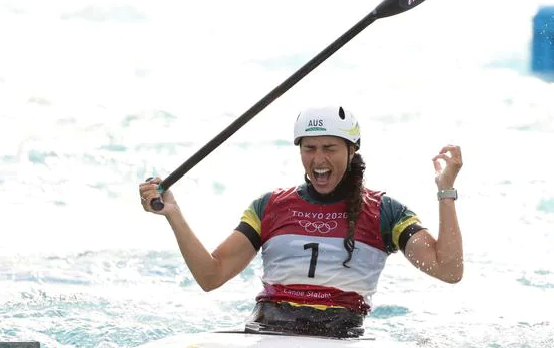
Like many Australians, I made sure I was in front the TV to watch Jess Fox’s gold medal performance last week in the C-1 Canoe Slalom at the Tokyo Olympics.

Jess is from a canoe and kayak paddling family – her parents are both Olympians in the sport, her mother is her coach, her father, Richard, was previously Australia’s Head Coach and is a Channel 7 commentator in these Olympics Games.

It was an absolute joy to hear Richard commentate on his daughter’s canoe race. His emotion was a rollercoaster ride that I shared.

After the race, Richard was talking about Jess’s preparation. He said that she had been under a lot of pressure but hadn’t let herself become stressed.

As a negotiator, this comment really stood out for me. In negotiations, just like in the Olympics, there’s nothing wrong with pressure but there is something wrong with stress.

According to HBR (Nicholas Petrie, 16/03/2017), pressure is not stress, but “the former is converted to the latter when you add one ingredient: rumination, the tendency to keep rethinking past or future events, while attaching negative emotion to those thoughts”.

It can be too easy to dwell on past negotiations or confrontations that have ended poorly. While it’s okay to feel under pressure to perform well, taking stress into a negotiation means you aren’t listening well to the other party, you are closed off to creative solutions, and you are too focussed on how you might be perceived.

Before a negotiation it’s important to prime yourself. Put things in perspective, think about past successes, let go of past failures and learn to control your reaction to pressure.

These steps will prepare you better for negotiation and, if you ever get the chance, Olympic Gold.

https://www.smh.com.au/sport/i-ve-thrown-up-but-it-s-fine-fox-s-nervous-battle-before-gold-run-20210729-p58e7s.html

It’s that time of year

It strikes me that some of our most fraught negotiations are not in the boardroom or during a mediation, but with family and friends in the lead-up to the holiday season.

Some of these holiday season negotiations rival the biggest corporate deals for complexity, number of parties, a protracted history of dealings and ever-changing power dynamics.

Simply planning a family get-together at Christmas time involves a negotiation about whose place it will be at, who is bringing what, who is driving home and what gifts to buy. There will planning needed for how to avoid the clash of personalities that arose last year and where to seat “that uncle” that everyone seems to have.

Here are my top three tips for negotiating the holiday season:

  1. Anchoring. In negotiation, the anchoring bias is the tendency to rely too much on the first piece of data. For holiday plans, anchor your desired outcome by being the first to suggest the plans. It is harder for others to adjust from the starting point and suggest alternatives if you’ve already named an offer.
    A polite “We’d like to have everyone over to our place this year” saves you the dreaded annual trek.
  2. Scenario Planning. If you suspect you will receive the same boring present or you’ll have guests offer to cook the same dated recipe, plan ahead for this. Work out how you’ll react in these circumstances. Good negotiators plan responses for a myriad scenarios. Try “I have always appreciated the effort you put into the Ham and Banana Hollandaise and this Christmas I’d love to honour you with a year off”.
  3. Pick your battles. There are times in a negotiation when offering a trade-off is the wrong approach. Christmas time with your family is probably the wrong time to hold out for a concession. I’m not suggesting you lie, but keeping the importance of the relationships top of mind is the proper thing to do. Instead of “why do we have to go your family’s house every year?”, try “I’ll happily tag along because I know it is important to you”.

I hope these tips help. Get in touch if I can help with any of your negotiations.

Fiona


Talking about female doctors

I recorded this podcast recently with Todd Fraser of Osler Technology. We are talking about how consensus-building negotiation skills can equip female doctors to receive more acknowledgement in the workplace, to negotiate better salaries and working conditions and neutralise the impact of bullying and hostility.

Take a listen … it’s only 15 minutes.

CLICK HERE: https://omny.fm/shows/essential-critical-care/fiona-mckenzie-negotiation-skills-for-female-docto?in_playlist=essential-critical-care!podcast-1#sharing


Grammar and Negotiation

We should settle

We could settle

We might settle

What are the different meanings here?

Did you know that grammar influences negotiation?

Words like should, could and might are called modal verbs. They modify the main verb in the sentence to make it weaker or to indicate likelihood. In the case above, they modify the verb settle.

Apart from modal verbs, there are other words that express modality. Words like think, suppose, unfortunately and probably. Look at these examples:

I think we can …

I suppose we can …

Unfortunately we can’t …

We probably won’t …

Why do we care about modality in negotiation? Because it changes the emotional tone of the negotiation.

If you want to deliver bad news without being abrupt, use modality: Instead of I am not doing that, use I am probably not able to do that.

If you want to ask the other party for a concession without committing to giving one, use modality: Instead of I will give you X if you give me Y, try If you give me Y I might be able to give you X

If you want to be crystal clear about an outcome or a condition, be sure not to use modality: Instead of I don’t think I could do that, use That is not possible.

And finally, one of my favourite tips, if you want to get something on the table without committing to it, use questions with modality, for instance: Should we consider… or Wouldn’t it be better to …

Language matters in negotiation. You may intuitively use these grammar techniques but it’s helpful to understand their power.


Anzac Parade

I was in Canberra last week delivering negotiation training for a federal government department.

I have always loved Canberra. As a child, I loved trying to guess which country’s embassy we were passing, and I was enthralled with the carillon. These days, it’s the design that draws me in. The grandeur and prominence of the key buildings, the roads and thoroughfares in geometric shapes and the elegance of the lake.

Last week was a work trip, so I was mostly just traipsing between the hotel and the client’s offices. However, each taxi trip landed me briefly on Anzac Parade, that glorious boulevard running from the War Memorial to the lake and looking directly across at the old and new parliament houses.

Anzac Parade is quite something. Visually, it is very commanding with the red gravel made from crushed Canberra bricks, and the rows of memorials flanked by towering trees.

I can’t help feeling that Anzac Parade is designed to prepare us for the sombre ceremonies held there. It’s priming us for solemnity and reverence.

Preparing for a negotiation is no different. Research shows that anxiety leads to poorer outcomes in a negotiation; to manage this, many people have rituals to ready themselves … wearing a much-loved shirt, eating a favourite breakfast, playing an inspiring soundtrack.

It’s important to build your very own rituals for the lead-up to a negotiation. It builds the connection in your brain to memories of prior negotiations and prepares you for what is to come.

What are your pre-negotiation traditions?